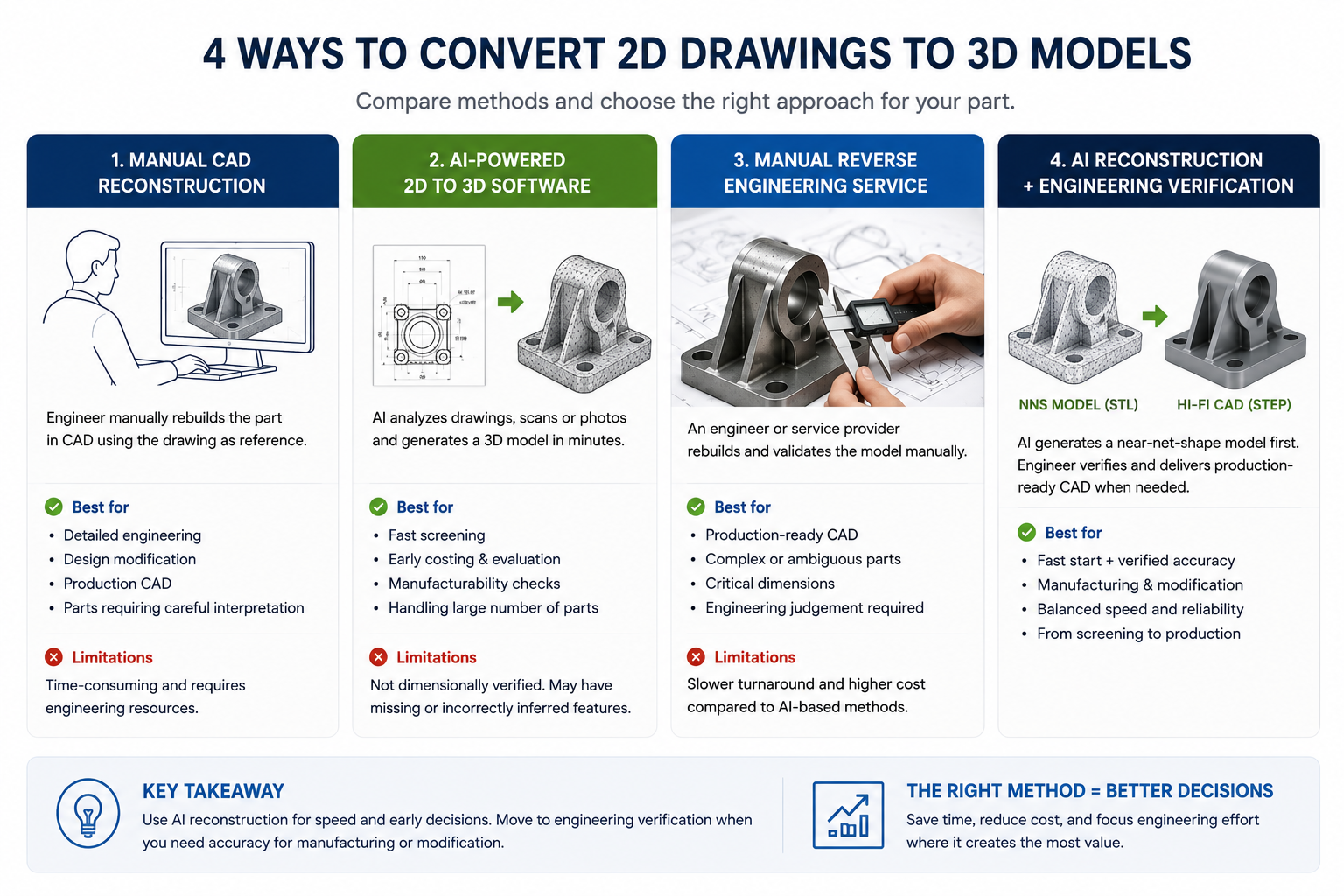
When the original 3D CAD model is missing, there are several ways to recreate a part from a 2D drawing, PDF, scan or photograph. You can rebuild the component manually in CAD, use an engineering service, or use AI-powered 2D-to-3D software to generate an initial model automatically. The right method depends on what you need from the output. A model for early costing or manufacturability analysis does not need the same level of verification as a CAD model that will be used for production.
This guide compares the main approaches.
1. Manual reconstruction in CAD software
Traditional CAD tools such as SOLIDWORKS, Autodesk Fusion or Onshape allow an engineer to recreate a component using the available drawing as a reference. The engineer interprets dimensions and views, creates sketches, and rebuilds features such as holes, pockets, extrusions and radii.
Best suited for
Detailed engineering
Design modification
Production CAD
Parts where geometry must be carefully interpreted
Cases where an engineer already knows the part needs to be manufactured
Main limitation
The process requires engineering time.
For one important part, this may be reasonable. For hundreds of old drawings, rebuilding every component manually before determining whether it is worth pursuing can become inefficient.
2. AI-powered 2D-to-3D software
AI software can automate the initial reconstruction. Instead of manually rebuilding every feature first, the user uploads the available source data and receives a generated 3D model.
With 3D Spark, supported inputs currently include:
PDF
PNG
JPG
SVG
DXF
DWG
Several sources can also be grouped into one part set. For example: technical drawing + two photographs of the physical part. The AI uses the available information together when reconstructing the component. The automatic conversion typically takes 5 to 30 minutes, depending on the input and how many model candidates need to be generated.
What does AI 2D-to-3D software actually produce?
This is where software comparisons can become misleading. Not every generated 3D model should be treated as production CAD. 3D Spark's automatic AI conversion produces an NNS Model, or Near-Net-Shape Model, delivered as an STL file.
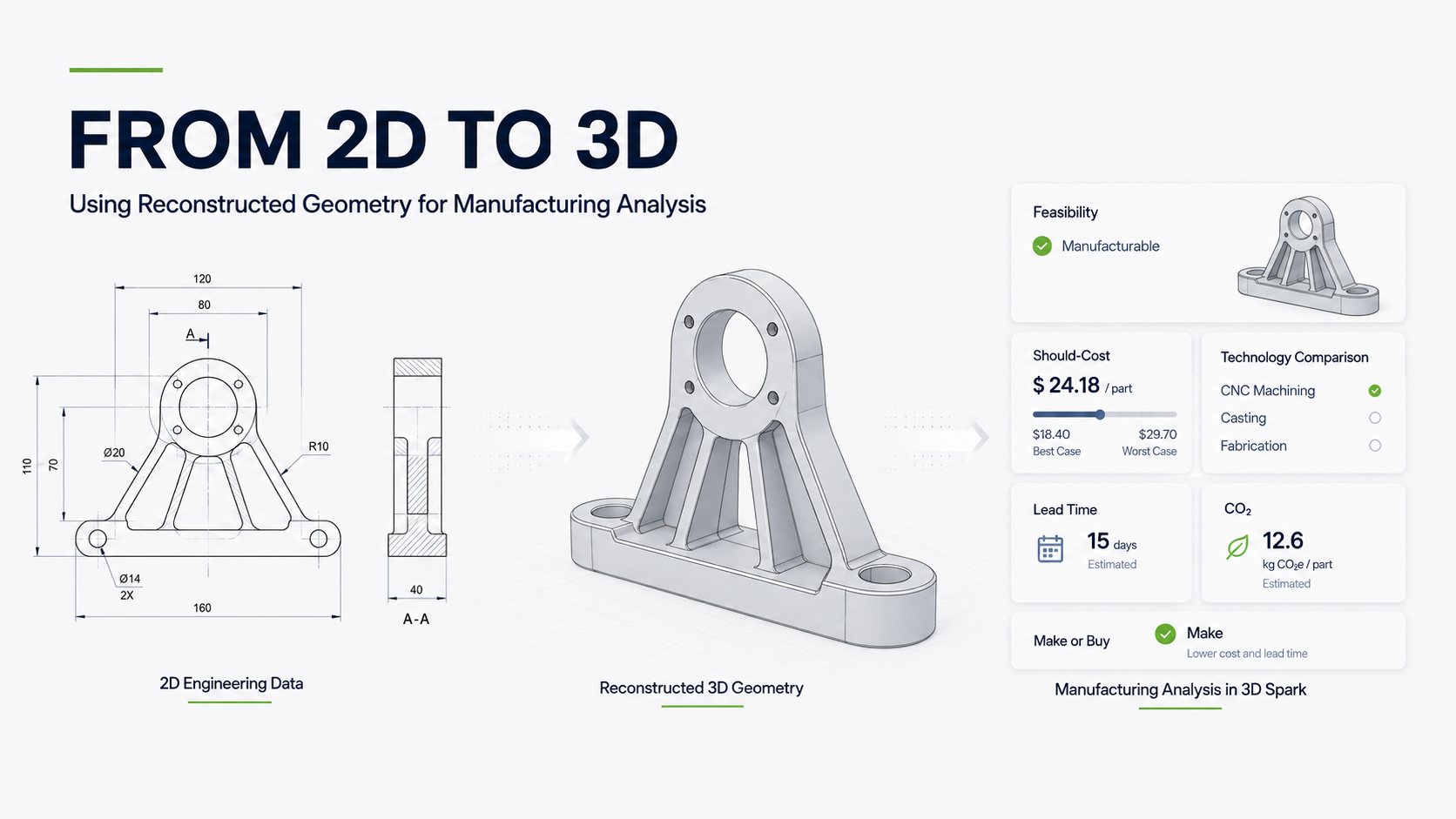
Its purpose is to provide geometry quickly for tasks such as:
Manufacturability checks
Technology selection
Part screening
Rough-order-of-magnitude costing
Early technical evaluation
3D Spark can generate up to three ranked NNS Model candidates for review. The user can select a result, rate it or regenerate the model. At least one model is delivered even if none fully clears the internal quality threshold, so the user still receives geometry to inspect. However, the NNS Model is not dimensionally verified and has not been reviewed by a design engineer.
Depending on the quality of the source data, the result may range from conceptual to genuinely near-net-shape. Features can also be missing or incorrectly inferred. This makes AI reconstruction useful for speed and screening, but not automatically suitable for production.
Another option is to send the drawing, scan or physical-part information to an engineer or specialist reverse-engineering provider. A human reconstructs and validates the model manually.
Best suited for
Production-ready CAD
Complex or ambiguous parts
Critical dimensions
Components that definitely need to be manufactured
Cases requiring engineering judgement
Main limitation
Manual reverse engineering provides more control, but it also requires more engineering effort and typically takes longer than automatic reconstruction. This creates an important question:
Do you need production-ready CAD immediately, or do you first need enough geometry to decide whether the part is worth pursuing? That is where a hybrid approach becomes useful.
4. AI reconstruction followed by engineering verification
3D Spark combines the speed of AI reconstruction with an engineering-reviewed route when higher fidelity is required.
The workflow has two levels.
NNS Model
AI-generated
Output: STL
Typical time: 5–30 minutes
Best for: screening, manufacturability, technology comparison, ROM costing and early evaluation
Dimensional verification: No
Hi-Fi CAD
When verified geometry is required, the AI-generated model can become the starting point for Hi-Fi CAD. An expert design engineer refines the model and verifies it against the available source information. The result is a production-ready, parametric solid CAD model, delivered as an editable STEP file.
Typical turnaround: 1–3 business days
Best for: manufacturing, modification and detailed engineering
Dimensional verification: Yes
Which 2D-to-3D method should you choose?
The best method depends on the next decision.
You need a quick 3D model for analysis
Use AI reconstruction.
An NNS Model can provide geometry in minutes for screening, costing or manufacturability evaluation.
You need editable production CAD
Use Hi-Fi CAD or detailed manual CAD reconstruction.
The model needs dimensional verification and engineering review before it should be relied on for production.
You have many legacy drawings
AI-first reconstruction can reduce the amount of manual CAD work required before identifying which components deserve deeper engineering.
You have incomplete information
Combine the available sources.
For example:
PDF drawing + photographs of the physical part
3D Spark allows multiple source files for the same component to be reconstructed together.
You already have valid 3D CAD
Do not reconstruct the model unnecessarily.
Use the existing geometry for the next engineering or manufacturing task.
AI vs CAD: it is not really an either-or decision
The most useful way to compare 2D-to-3D software is not AI versus engineers. They solve different stages of the workflow.
AI is useful when the priority is: speed, screening and early evaluation
Engineering review becomes important when the priority is: dimensional accuracy, modification and production
This allows companies to apply detailed engineering effort where it is actually needed rather than rebuilding every historical part manually from the beginning.
With features to make every step of your manufacturing business more efficient and scalable, coupled with a support team excited to help you, getting started with 3D Spark has never been easier.


)%20(1).avif)