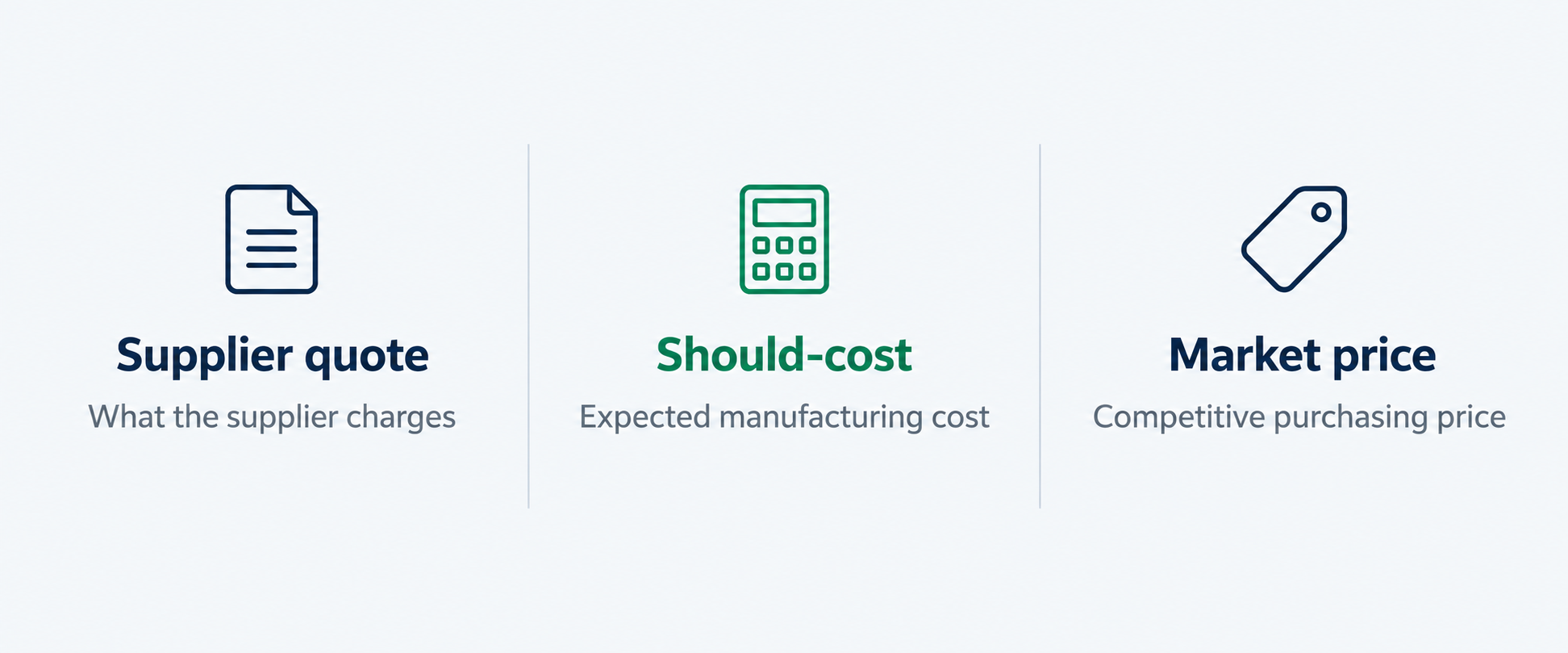
Large manufacturers may purchase hundreds or thousands of CNC-machined parts across different suppliers, plants and regions. Some parts will be priced competitively. Others may cost more because of demanding technical requirements, small order quantities or short delivery times. But there may also be parts where the supplier price is much higher than the expected manufacturing cost.
The challenge is finding those parts without manually analysing every drawing and quotation.
Why is it difficult to find overpriced CNC parts?
Procurement teams usually have supplier prices, order quantities and purchasing histories. Engineering teams have drawings, CAD files and material specifications. The information exists, but it is often stored in different systems and evaluated separately. A high unit price alone does not tell you whether a part is overpriced. The price may be justified by complex machining, expensive material, tight tolerances or inspection requirements. A lower-priced part can also create a larger saving opportunity if it is purchased in high quantities.
This means procurement needs to consider both the price difference and the total buying volume.
Manual should-costing does not scale easily
A cost engineer can create a detailed calculation for an individual CNC part. This works well for a few strategic components. It becomes difficult when the portfolio contains hundreds or thousands of parts. Manually reviewing every drawing requires significant time and specialist knowledge. It can also lead to inconsistent results when different people use different assumptions for machine rates, setup times or manufacturing steps.
Instead of calculating every part in detail from the beginning, procurement can first screen the portfolio and identify where a deeper review is most valuable.
Start with the available part data
A portfolio analysis can use information such as:
- CAD files and technical drawings
- Material specifications
- Current supplier prices
- Lot sizes and annual quantities
- Annual purchasing volume
- Supplier and plant information
- Sourcing regions
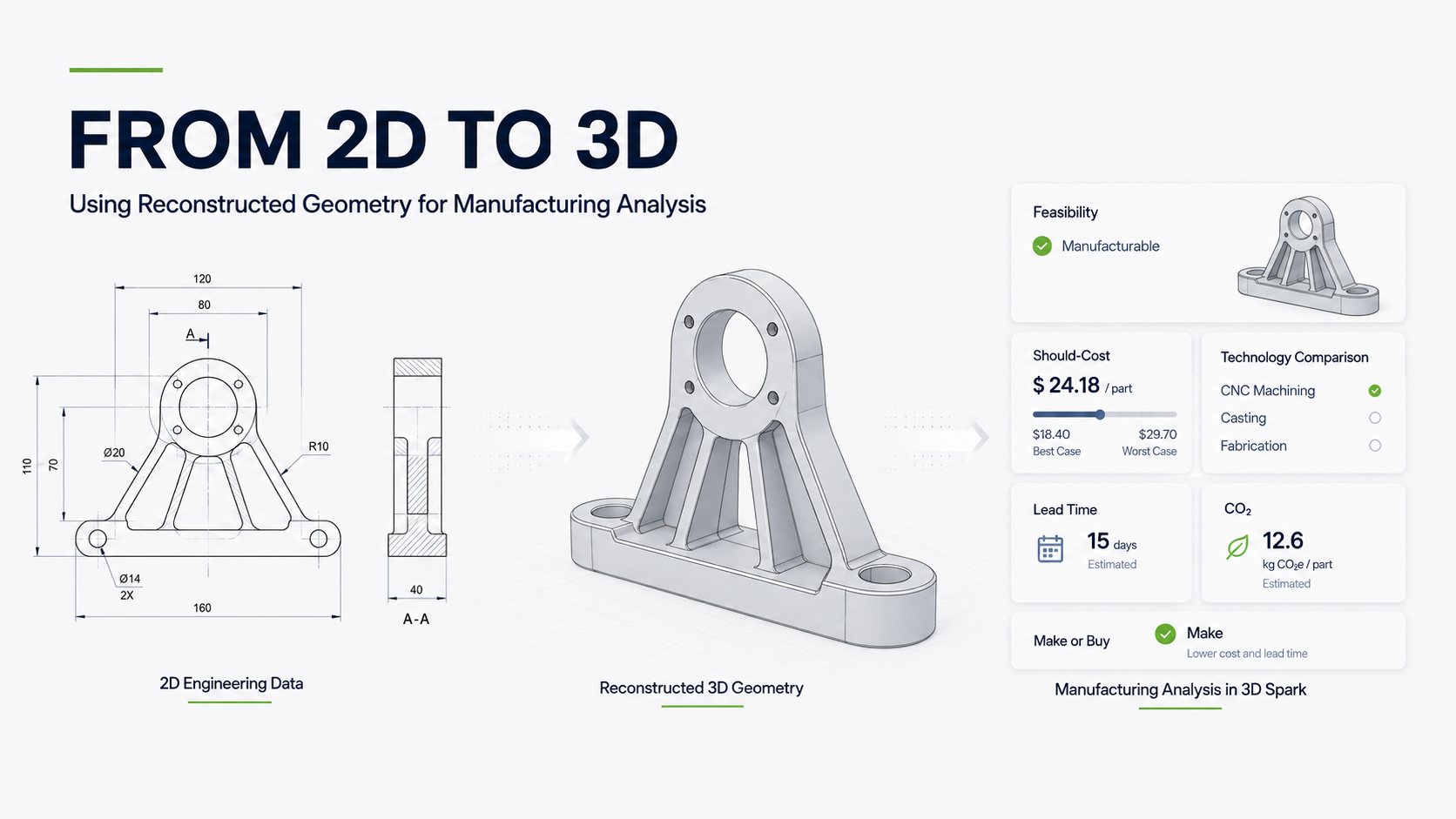
3D Spark analyses the available part data and simulates the expected manufacturing process. This creates a process-based should-cost breakdown for each CNC-machined part. The result can then be compared with the current supplier price and expected market price.
Look for cost outliers
A cost outlier is a part whose supplier price differs significantly from its expected manufacturing or market price.
Several factors can create this difference:
- An inefficient manufacturing process
- Unfavourable raw material dimensions
- Too many machining setups
- An unsuitable machine selection
- An outdated supplier quotation
- Low competition among suppliers
- A change in annual demand
- Special inspection or documentation requirements
Finding a cost outlier does not automatically mean that the supplier is charging too much.
It means the price needs a closer look.
Validate the highest-potential parts
Portfolio screening should produce a focused list of parts for further review.
Procurement, engineering and cost experts can then validate:
- The material and stock dimensions
- The expected machining steps
- The machine selection
- Setup and machining time
- Lot size
- Tolerances and surface requirements
- Inspection, certification and documentation costs
This validation separates genuine saving opportunities from price differences that have a valid technical or commercial reason.
Turn the analysis into action
Once the cost drivers are clear, procurement has three main ways to act.
Challenge the current supplier
Use the should-cost breakdown to discuss specific differences in material, setup, machining or additional costs.
Benchmark supplier prices
Compare different quotations against the same manufacturing-based reference. This gives procurement more information than comparing final prices alone.
Compare sourcing regions
Review whether another sourcing region could offer a more competitive market price while still meeting the required quality, delivery and capacity conditions. The right action depends on the part and the supplier relationship.
Focus your experts on the parts that matter
Automated portfolio analysis does not replace procurement experience or cost-engineering expertise. It helps those teams use their time more effectively. Instead of manually searching for potential savings, experts can focus on validating the highest-value opportunities and preparing the right supplier action.
The approach is simple:
Screen the portfolio. Find the cost outliers. Validate the breakdown. Act on the parts with the greatest saving potential.
Want to find the cost outliers across your CNC part portfolio? Get a quote from 3D Spark.


)%20(1).avif)