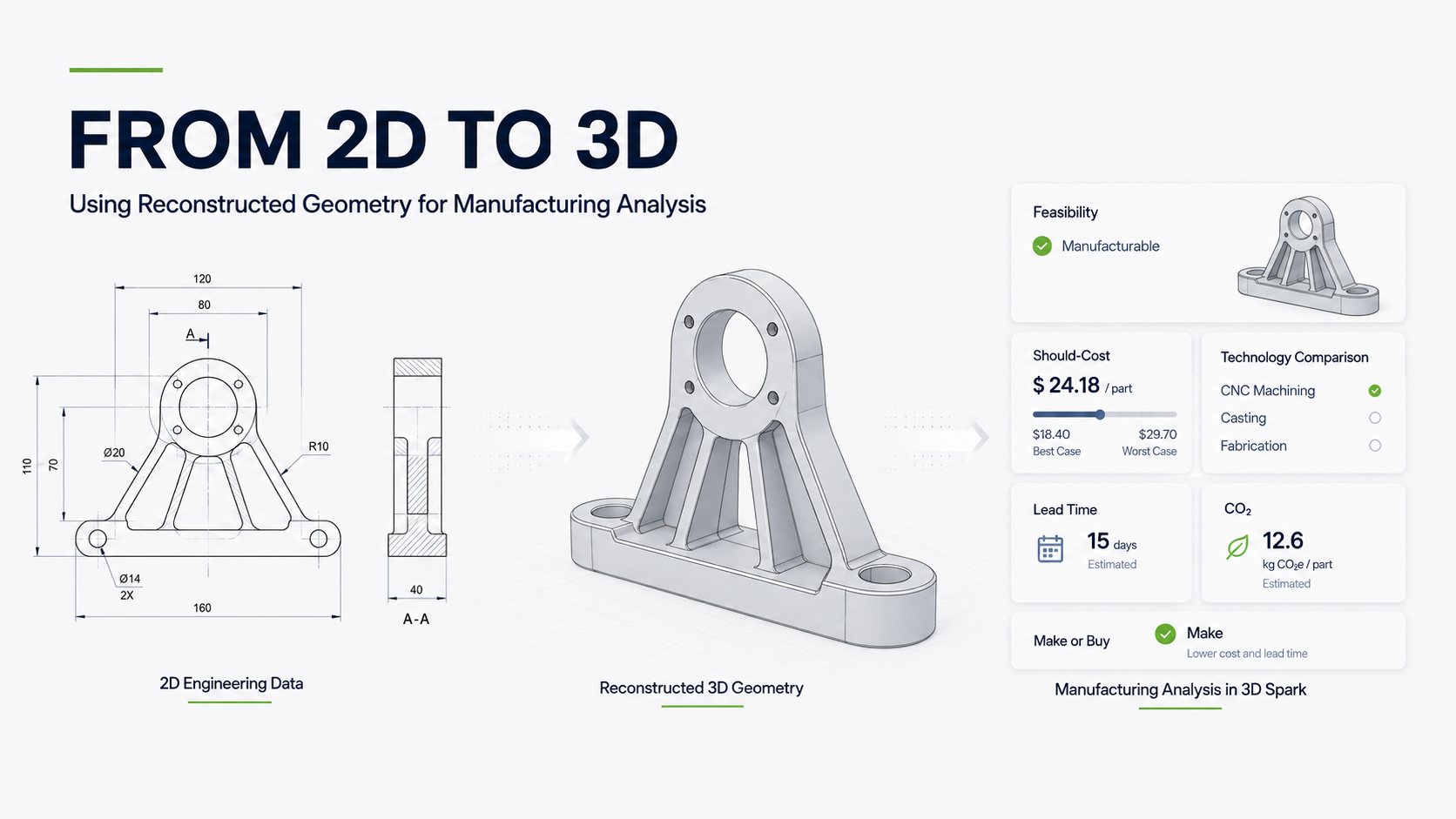
From 2D Drawing to 3D Model: Recover Critical Spare Parts Faster
3D Spark
August 5, 2026
A critical spare part fails. The supplier no longer supports it. The lead time is too long. The original CAD file is missing. All that remains is an old technical drawing or a photo of the part. This is a common problem for MRO, maintenance, procurement, and engineering teams in rail, aerospace, automotive, and industrial manufacturing. Assets stay in operation for decades, but suppliers, software systems, and engineering records change. The result is often the same: the part still exists, but the data needed to source or manufacture it does not.
Why missing CAD becomes an operational problem
Without usable 3D geometry:
Maintenance teams struggle to replace obsolete parts
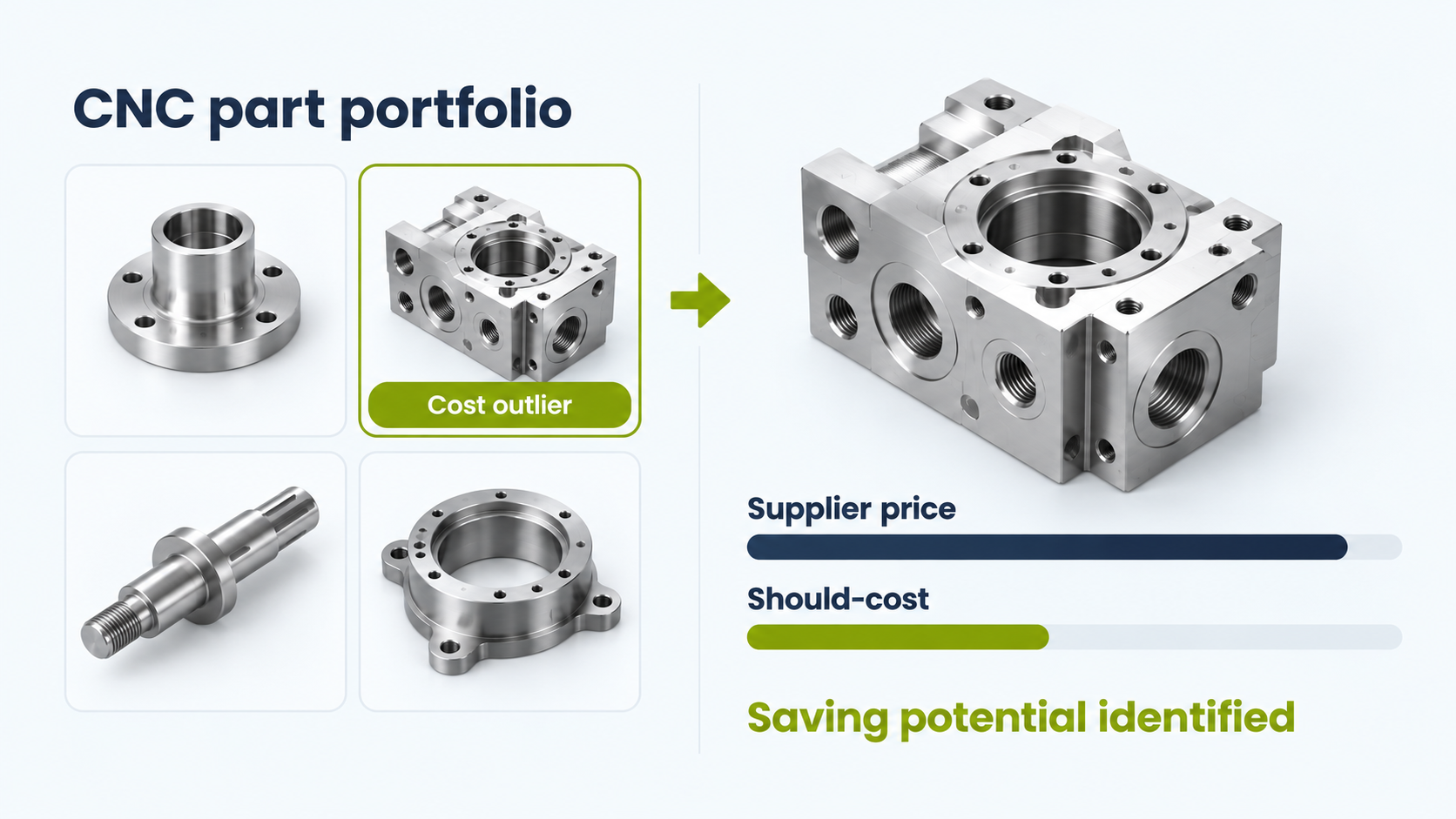
Procurement has limited visibility into realistic manufacturing costs
Engineers spend time manually rebuilding simple components
Alternative manufacturing processes are difficult to compare
Companies remain dependent on a single supplier
Valuable part knowledge stays locked in old drawings and local archives
A small unavailable component can stop a high-value machine, production line, rail vehicle, or maintenance operation. The cost of the downtime may be far greater than the cost of the part itself. 3D Spark helps companies turn legacy 2D drawings or images into usable 3D data. Users can choose between two outputs:
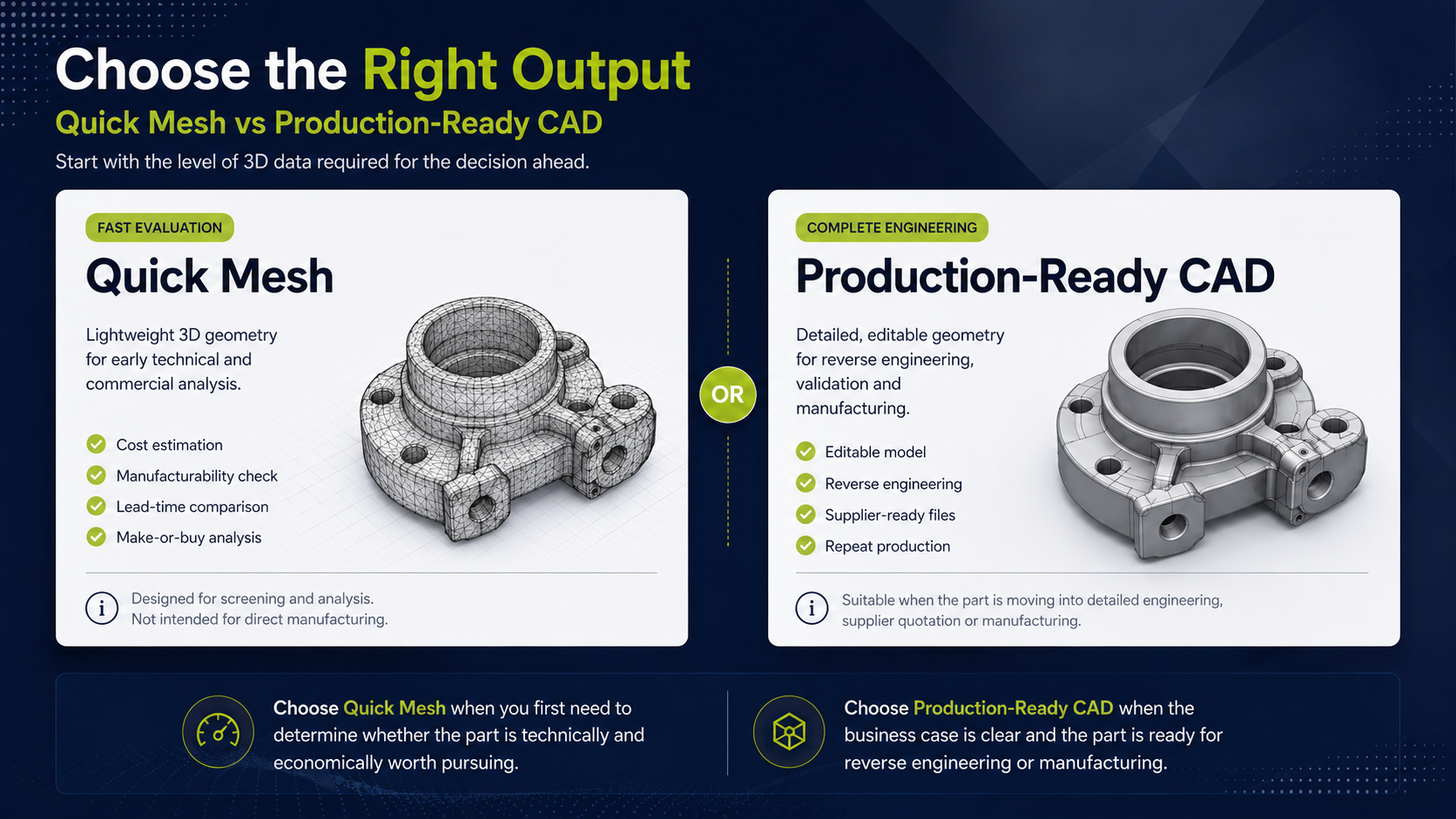
A quick mesh for cost and manufacturing analysis
Production-ready CAD for full reverse engineering
This creates a faster path from an old drawing to a sourcing or manufacturing decision.
Quick mesh for cost and manufacturing analysis
A quick mesh provides enough geometry for early technical and commercial evaluation.
Use it to:
Estimate manufacturing costs
Check manufacturability
Compare production technologies
Evaluate lead times
Support make-or-buy decisions
Screen large spare-parts portfolios
Identify suitable additive manufacturing use cases
This option is useful when the first question is: Is this part technically and economically worth pursuing? The mesh is intended for analysis, not direct manufacturing.
Production-ready CAD for full reverse engineering
Production-ready CAD is suited to parts that will move into detailed engineering or manufacturing.
Use it to:
Rebuild missing engineering data
Manufacture replacement parts
Modify or redesign legacy components
Prepare supplier-ready files
Support repeat production
Create a validated digital spare-part record
This avoids investing in full reverse engineering before the business case is clear.
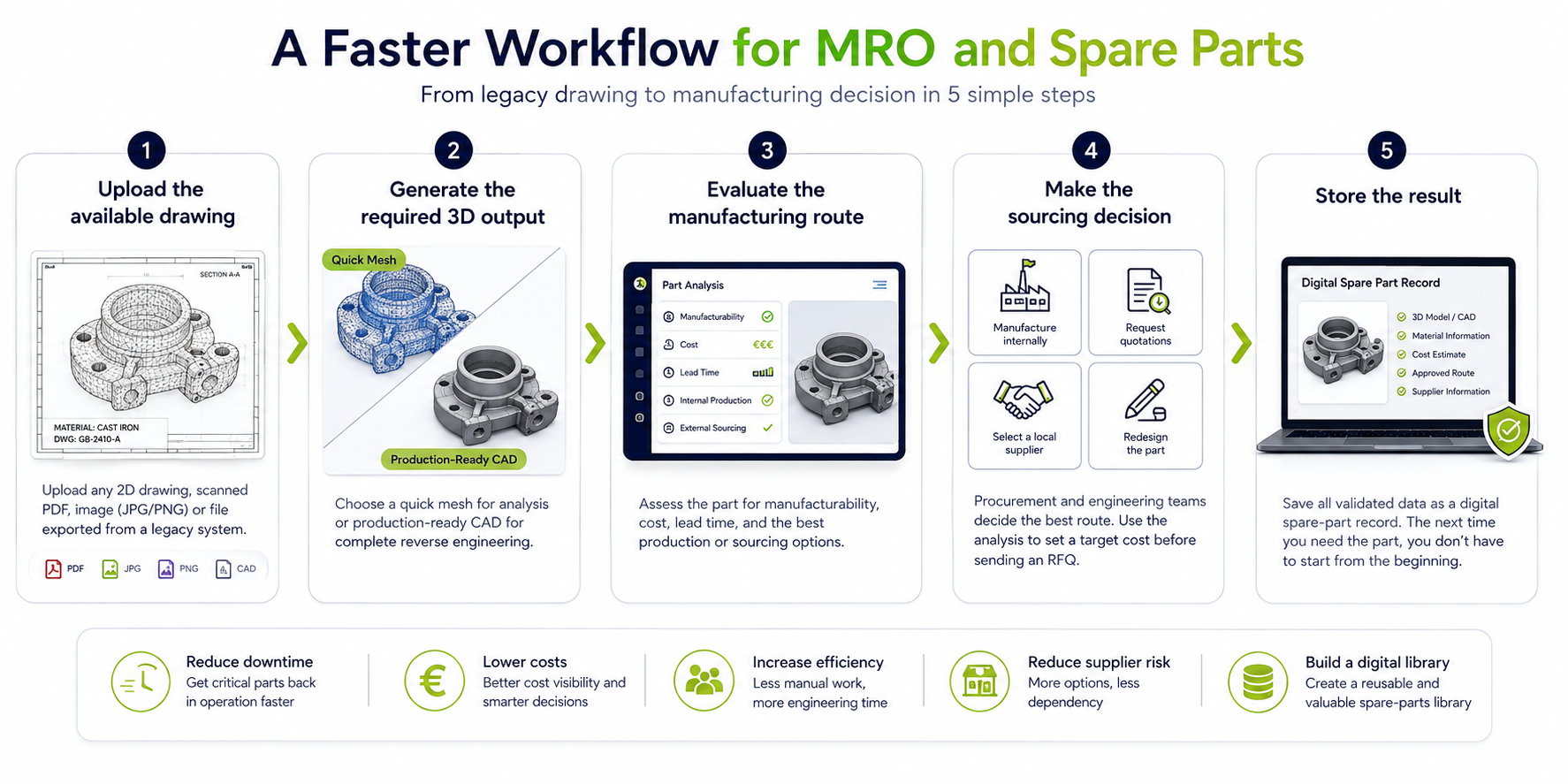
A faster workflow for MRO and spare parts
The process can be kept simple.
1. Upload the available drawing
The input may be a PDF, scanned drawing, JPG, PNG, or drawing exported from a legacy system.
2. Generate the required 3D output
Choose a quick mesh for analysis or production-ready CAD for complete reverse engineering.
3. Evaluate the manufacturing route
Once the geometry is available, the part can be assessed for:
Manufacturability
Cost
Lead time
Internal production
External sourcing
4. Make the sourcing decision
Procurement and engineering teams can then decide whether to:
Manufacture internally
Request quotations
Select a local supplier
Redesign the part
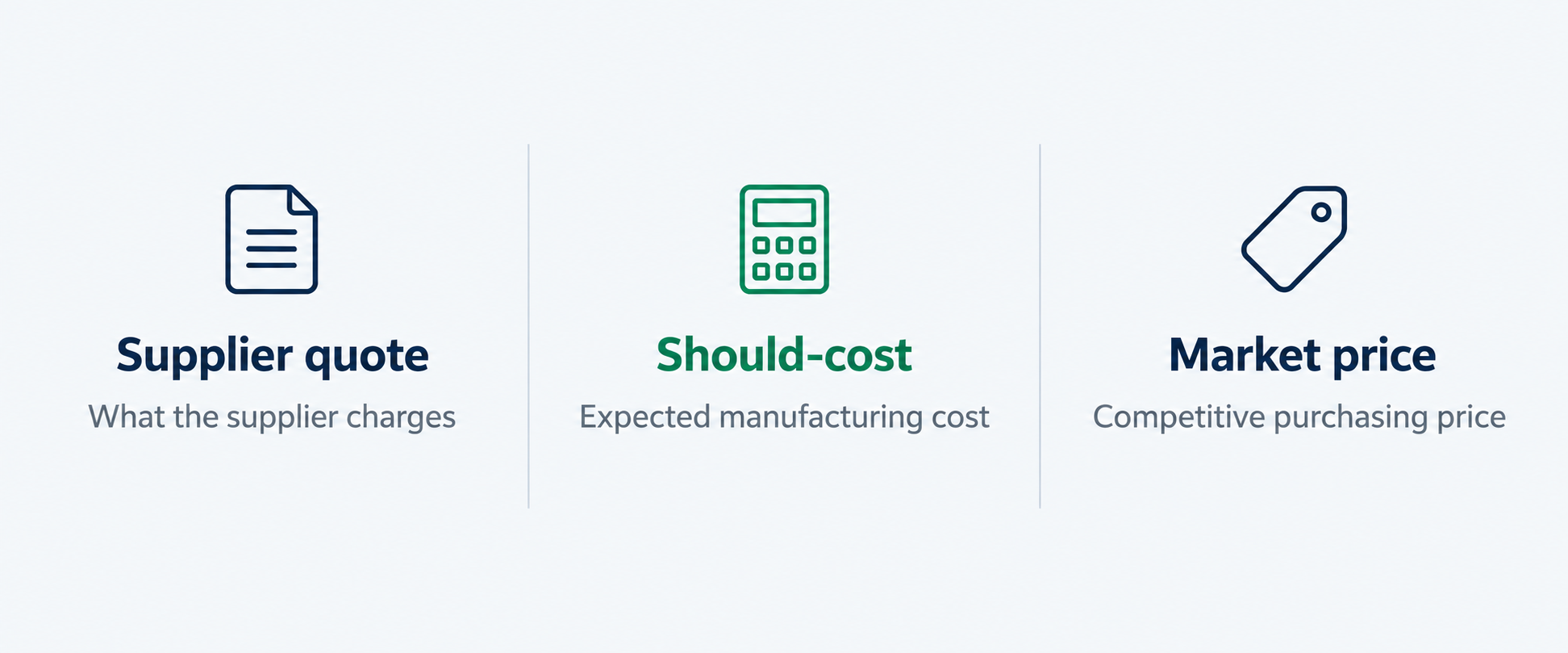
The same analysis can also provide a target-cost reference before an RFQ is sent.
5. Store the result
Once validated, the drawing, model, material information, cost estimate, and approved manufacturing route can be stored as a digital spare-part record. The next time the component is needed, the organisation does not have to restart the process.
Turn legacy drawings into manufacturing decisions
The value of 2D to 3D conversion is not the model alone. It is the decision that follows. Maintenance can evaluate a faster replacement route. Procurement can compare costs and suppliers. Engineering can focus on validation. The organisation can reduce supplier risk and build a reusable digital spare-parts library. Choose a quick mesh when you need fast answers. Choose production-ready CAD when you are ready to reverse engineer and manufacture the part.
Upload your technical drawing and identify the best next step for your critical spare parts by clicking here.
Convert your file for free or Book a demo!
Upload your part and get started for free
Try our platform for free by uploading your 2D and receive it's 3D version!
With features to make every step of your manufacturing business more efficient and scalable, coupled with a support team excited to help you, getting started with 3D Spark has never been easier.


)%20(1).avif)