Converting a 2D technical drawing or an image of a spare part into a 3D model traditionally requires an engineer to interpret the available information and rebuild the component manually in CAD. AI-assisted 2D-to-3D conversion can automate much of this first reconstruction step. For engineering, MRO and procurement teams, this is particularly useful when the original CAD file is missing but a technical drawing, PDF, scan or photo still exists.
The important question is not simply whether AI can generate a 3D shape. It is what level of 3D geometry is required for the next technical task.
How does AI convert 2D data into a 3D model?
A technical drawing contains geometric information that can be used to reconstruct the part in three dimensions. Depending on the drawing, this can include:
Front, side and top views
Dimensions
Diameters and radii
Hole positions
Section views
Internal and external features
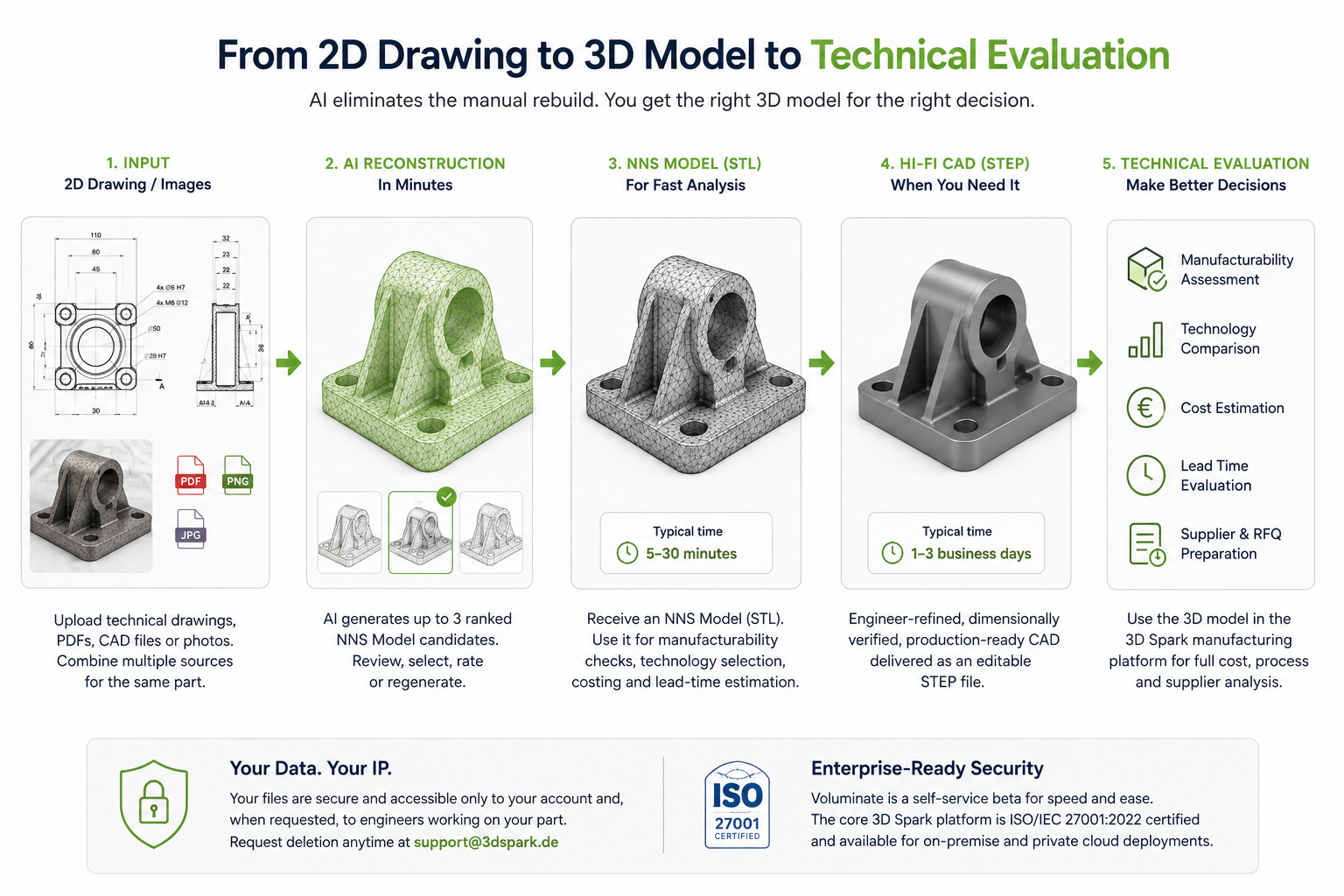
AI-assisted reconstruction interprets this information and combines the available views to estimate the three-dimensional geometry of the component. Images can also be used when a formal technical drawing is unavailable. In practice, the more useful information the system receives, the better the basis for reconstruction. With 3D Spark's workflow, multiple sources belonging to the same component can be grouped into a single part set. For example, a technical drawing can be combined with two photographs of the physical part and reconstructed together. This is especially useful for legacy and spare parts where the available technical documentation is incomplete.
What file types can be used?
3D Spark currently accepts:
PDF
PNG
JPG
SVG
DXF
DWG
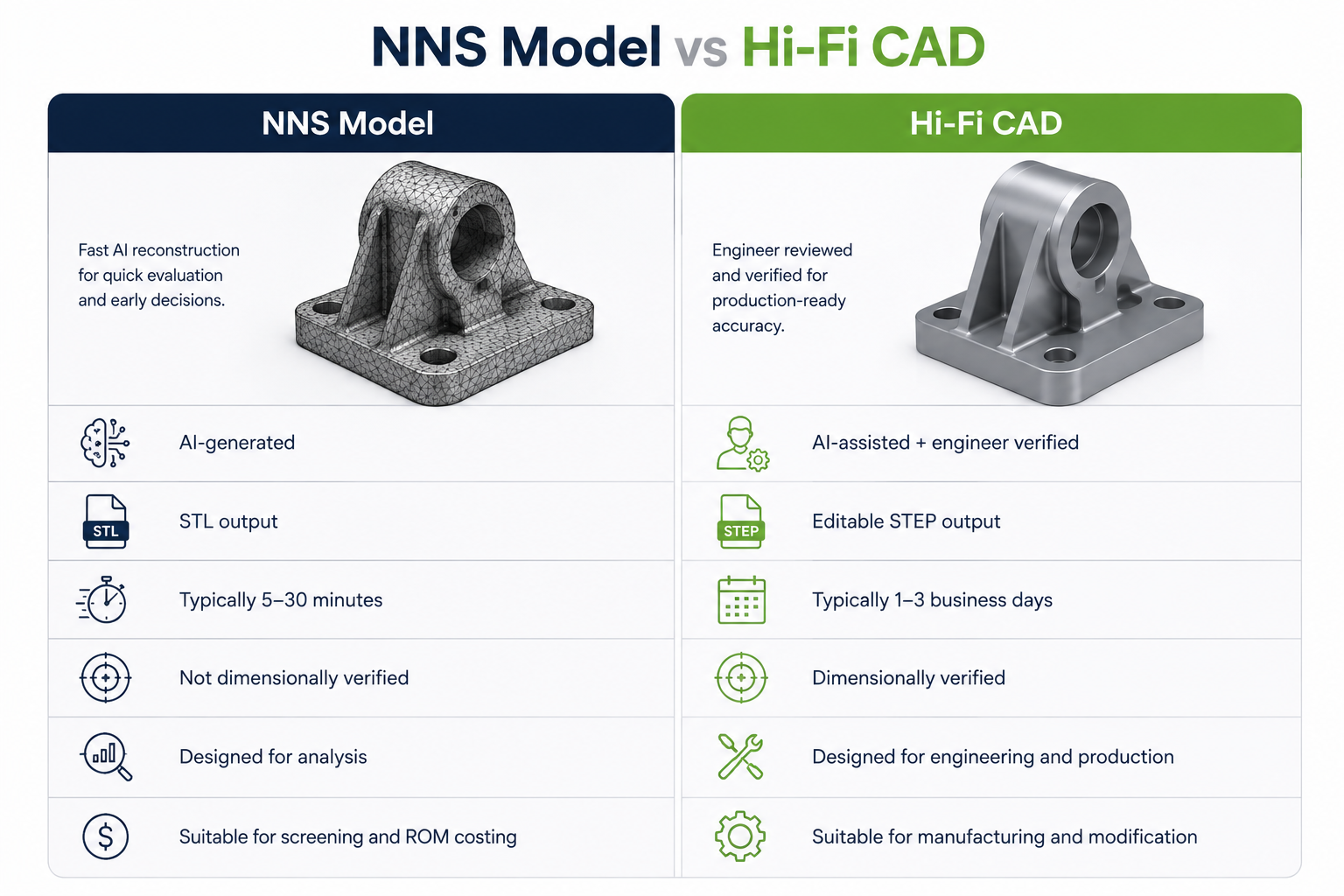
The automatic AI conversion returns an NNS Model, or Near-Net-Shape Model, as an STL file. If the component requires dimensionally verified engineering geometry, the workflow can instead continue to Hi-Fi CAD, which is delivered as an editable STEP file. This distinction matters because an automatically generated model for analysis and a production-ready engineering model serve different purposes.
What is an NNS Model?
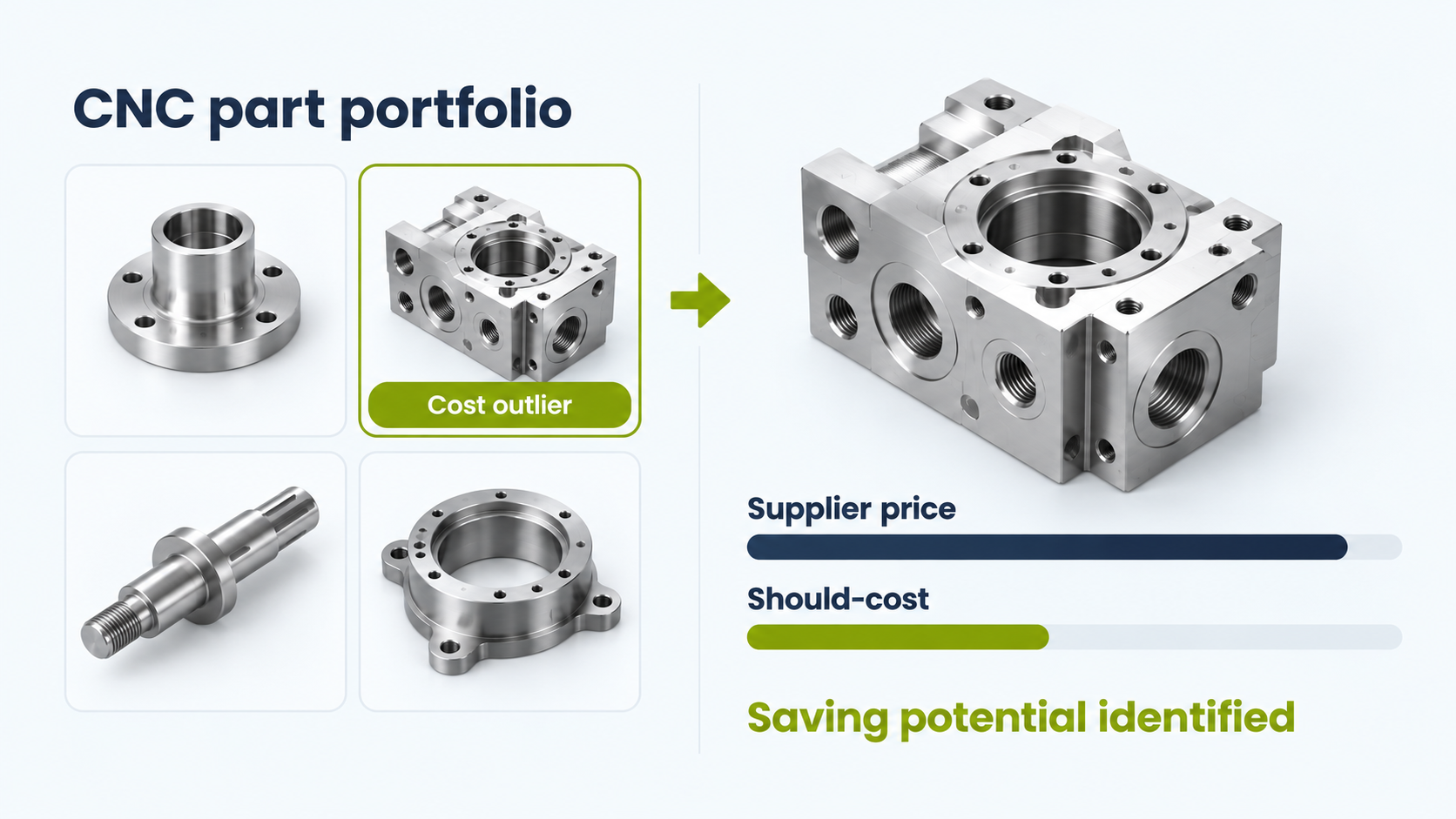
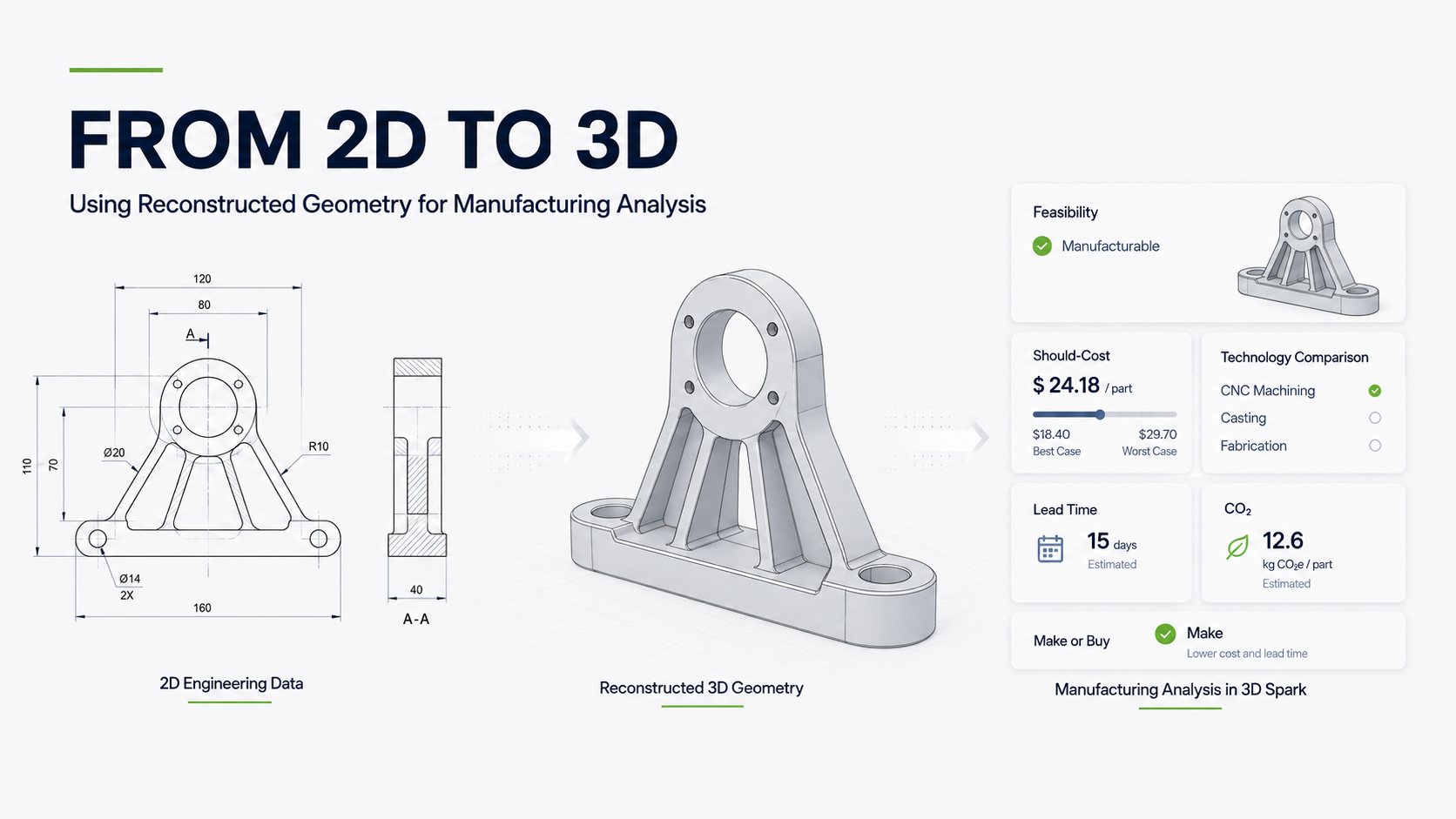
The free AI conversion creates an NNS Model, short for Near-Net-Shape Model. It is intended to provide usable 3D geometry quickly for early technical and commercial evaluation. Typical applications include:
Manufacturability checks
Manufacturing technology selection
Part screening
Rough-order-of-magnitude quoting
Cost evaluation
Early feasibility assessment
The AI reconstruction typically takes 5 to 30 minutes, although more complex inputs may take longer. The platform can generate up to three ranked NNS Model candidates for the user to review. A candidate can be selected, rated or regenerated. At least one model is delivered even when none of the generated candidates completely meets the system's internal quality threshold. This gives the user geometry to inspect rather than ending the process without a result. The important limitation is that an NNS Model is not dimensionally verified and has not been reviewed by a design engineer. Depending on the input, its quality may range from conceptual geometry to a genuinely near-net-shape reconstruction. Features can occasionally be missing or incorrectly inferred. For that reason, the STL should be treated as an analysis model rather than production CAD.
What determines 2D-to-3D model quality?
There is no single accuracy percentage that applies to every automatic 2D-to-3D model conversion. The quality depends heavily on the available source data.
Complete views reduce ambiguity. A drawing containing several orthographic and section views provides more geometric information than a single view.
Clear dimensions help define the size and position of features.
High-quality source files are easier to interpret than blurred, damaged or low-resolution scans.
Part complexity also matters. Straightforward mechanical geometry is generally easier to reconstruct than complex freeform surfaces or poorly documented internal features.
Most importantly, AI cannot reliably recover engineering information that is absent from the source material. This is why the intended use of the output matters as much as the reconstruction itself.
NNS Model vs Hi-Fi CAD
When a component needs to move from initial analysis toward manufacturing, a higher level of engineering verification is required. This is where Hi-Fi CAD, or High-Fidelity CAD, fits into the workflow. Hi-Fi CAD starts with an AI-generated reconstruction, but an expert design engineer then refines and verifies the model against the available source data. The result is a production-ready, parametric solid CAD model delivered as an editable STEP file.
The advantage of this two-stage approach is that full engineering effort does not need to be invested immediately. A team can first generate an NNS Model, investigate the part, and then request Hi-Fi CAD only when the component actually needs production-ready geometry.
NNS model vs HI-Fi CAD
A faster route from missing CAD to usable 3D data
AI-based 2D-to-3D conversion does not eliminate the need for engineering validation. What it changes is when that detailed engineering effort becomes necessary. Instead of rebuilding every component manually from the beginning, teams can use AI to generate an NNS Model first:
Drawing, PDF or image → AI reconstruction → NNS Model
If the component only needs screening, costing or technical evaluation, that may already provide the required geometry. If the part moves toward production:
NNS Model → engineering refinement and verification → Hi-Fi CAD
3D Spark's 2D to 3D workflow
This gives engineering, MRO and procurement teams a faster way to work with legacy parts while keeping the distinction between AI-generated analysis geometry and production-ready CAD clear.
With features to make every step of your manufacturing business more efficient and scalable, coupled with a support team excited to help you, getting started with 3D Spark has never been easier.


)%20(1).avif)